Mersive Release Notes
Release notes for Mersive software updates can be found here, with the most recent release first:
September 2026
This release transforms the Mersive room experience by making your meeting spaces active participants in Microsoft Teams. Rooms can now join Teams meetings as named, authenticated participants using your organization's Microsoft tenant, creating a more seamless and professional meeting experience. With this release, users can quickly view upcoming meetings and start them directly from the Mersive client, eliminating the need to search for meeting links or invitations.
This release also brings several usability and management improvements, including:
Restored network configuration management through the Mersive Portal.
Reduced notification email volume to help minimize inbox clutter.
Added numerous enhancements and bug fixes across both the Mersive Portal and client applications for a smoother, more reliable experience.
Together, these updates make it easier to manage rooms, join meetings, and keep teams productive.
New - Microsoft Teams
Auto-join Your Next Meeting
Connect your Microsoft calendar from the Mersive client, and your next meeting appears ready to start with a single tap. You can also join manually by entering a meeting ID. Your calendar connection is remembered, so you only need to sign in once.
The room Joins as Itself
The Mersive room signs in using your organization's Microsoft room account, so it appears in the Teams participant list with its room name instead of as a guest. For meetings within your organization, the room joins directly without waiting in the lobby.
Your Tenant, Your Calling
Teams calling runs through your organization's Microsoft services. Calling minutes remain within your Microsoft agreement, and meeting traffic is not routed through Mersive.
Set it up Once, From the Portal
A new Microsoft Teams section in the Portal Integrations area guides administrators through connecting their organization and signing in to the room account. Administrators can configure the integration through a documented self-service process and disable it at any time.
Built for What's Next
The meeting join experience has been redesigned to support additional meeting platforms in the future, with Microsoft Teams available first.
New
Mobile sharing is easier to find
Visiting the Mersive web app from a phone or tablet now directs users to the Mersive Connect app for iOS and Android.
Bulk Onboarding You Can Walk Away From
Bulk onboarding jobs now have their own status page, so you can refresh the browser, navigate away, and return later to check progress.
Improved
Device deletions, firmware updates, and deployment updates are now grouped into a single digest instead of generating an email for every event.
Activation, account, and notification emails now use a unified template and footer for a more consistent experience.
Rewritten sign-in and meeting join messages across the Portal, client, and room display in clearer, more user-friendly language.
Updated core platform libraries to address known security vulnerabilities.
Fixed
Portal
Resolved an issue that prevented device network settings from loading or saving correctly in the Portal.
Fixed an issue where users signing in through single sign-on appeared without names in the Users list.
Removed unsupported sharing settings from Templates until full device support is available.
The welcome email sends cleanly. Fixed a formatting issue that could prevent the new license welcome email from being delivered correctly.
Sharing and Displays
Fixed an issue where selecting Make Fullscreen from a shared item did not expand content to fill the display as expected.
Fixed an issue on Pod Pro systems with dual displays where display mode could unexpectedly switch from Extended to Mirrored during startup.
August 2026
This release combines new capabilities with important platform reliability improvements. It also introduces digital signage caching and a new bulk device information endpoint, while addressing stability, performance, and security issues identified through ongoing platform reviews.
New
Digital Signage Caching
Videos uploaded to a space can now be cached directly on devices and played from local storage instead of streaming. This reduces reliance on network connectivity and helps ensure content continues playing even when internet access is unavailable.
SSO Integration
The first phase of SSO support with Ping Identity integration is now active, with upcoming support planned for Microsoft Azure AD, Okta, and Google.
Preferred Playback from Device Memory
Administrators can now choose cached video as the primary playback source instead of using it only as a fallback option. The interface has been updated to Upload Video and includes a setting to play cached content from device memory by default.
State-Based Signage Videos
You can now assign different cached videos to each room state. This lets signage content change automatically based on room availability or status.
Bulk Device Information Endpoint
A new endpoint allows administrators and integrations to retrieve the status of multiple devices in a single request. This simplifies large-scale device management and reduces the need for individual device queries.
Improved
The Devices page now uses pagination, improving performance and reducing resource usage when managing large device fleets.
License generation now processes large orders in batches, allowing organizations to create large numbers of licenses without previous fulfillment limitations.
Sleep, wake, and reboot scheduling endpoints now require authentication. This update removes unintended public access and improves overall platform security.
The calendaring bulk endpoint now validates organization access, ensuring users can only retrieve data for organizations they belong to.
The calendaring bulk endpoint has been optimized to prevent unnecessary requests that could delay processing and consume gateway resources.
Fixed
Signage and Idle Screen
The Cannot Be Booked rule now works correctly when calendar integration is disabled at either the device or organization level.
When you replace a signage video, the thumbnail now updates immediately without requiring a page refresh.
Old signage video files are now automatically removed from device storage when they are replaced, preventing unnecessary disk usage.
The meeting information card on Chromecast now displays within a properly sized container for a cleaner viewing experience.
Mersive Smart no longer crashes on Chromecast devices when a plan is assigned during initial onboarding.
Device Onboarding and Licensing
A device serial number can no longer be registered as an active device in multiple organizations at the same time.
User invitations now remain valid when opened, resolving issues that caused invitations to appear expired immediately.
Upgrading to version 18.0.4 no longer gets stuck in an endless updating state within the Portal.
Firmware release notification emails are now sent successfully, ensuring customers receive update announcements as expected.
Platform Reliability
Orphaned sleep, wake, and reboot schedule jobs are now automatically detected and removed after devices or organizations are deleted. This prevents scheduler limits from being reached and ensures new schedules can be created successfully.
Device settings and status lookups now handle missing records correctly, preventing unnecessary retry loops for deleted devices.
Expired screen key cleanup now runs in batches, improving reliability and ensuring cleanup tasks complete successfully in large environments.
Deployment status checks now stop once a deployment reaches a final state, reducing unnecessary background processing.
Account creation and invitation errors now report their actual error type, making troubleshooting easier and more accurate.
Reliability Improvements
Additional fixes address several medium-severity issues, including scheduler authentication problems, onboarding edge cases, error handling gaps, and background processing failures.
The Next.js 16 upgrade introduced image-loading issues, which have been resolved.
Portal and Device Settings
The HDMI-In Behavior setting is no longer displayed for Mini devices because they do not support HDMI input.
18.1 Update
Fixed
Proxy Configuration Updates
Resolved an issue where proxy settings configured in the Portal were not being fully applied to devices. Previously, proxy settings appeared to save successfully, but only proxies configured during initial AP mode onboarding were functioning correctly. With this fix, enabling or disabling a proxy from the Portal is now reliably applied to devices, ensuring consistent network connectivity and communication.
Resolved Static IP Connectivity Issue After Upgrade
Fixed an issue that could cause devices using static IP configurations to lose network connectivity after upgrading to version 18.0.4. In some cases, devices with older static IP settings were missing required network prefix information, causing them to come online without a usable network connection. Devices now retain proper network settings after upgrading, preventing connectivity disruptions.
2.9.1 Patch Release
Improved
SSO Configuration Improvements
Administrators can now view the Service Provider URL and Entity ID immediately after selecting an identity provider, making SSO configuration more straightforward. Verification certificates can be uploaded directly instead of being manually pasted, and the organization sign-in page now displays the configured identity provider name for a clearer user experience. Organizations using SSO will also benefit from a more streamlined authentication workflow.
Enhanced API Security
We applied improved security protections to API gateway routes to ensure all applicable endpoints require proper authentication and authorization.
Fixed
Templates
Assigning a template to an onboarded device no longer affects network configuration.
Resolved an issue where applying a template to an already onboarded device could prevent network settings from loading correctly. Devices can now receive template updates without impacting network configuration or Wi-Fi management.
Enabling calendar in a template no longer hides connection instructions.
Fixed an issue where enabling calendar integration through a template could unintentionally suppress connection instructions on the idle screen. Calendar settings now behave consistently with device-level configuration, ensuring connection instructions remain visible unless explicitly configured otherwise.
HDMI-In option restored to templates.
Administrators can once again configure the Include HDMI-In in idle screen connection instructions setting through templates, making it easier to create template configurations that match device-level settings.
Licensing and Networking
License generation now supports large orders more reliably.
Improved license creation processing to better support large license orders. License generation now handles higher-volume requests more efficiently, ensuring all licenses associated with an order are successfully created.
WAP Wi-Fi settings now appear correctly in the Portal.
Resolved an issue where Wi-Fi settings configured during WAP-mode onboarding were not displayed in the Portal. Wi-Fi configurations created during setup now import properly and appear in the device networking settings.
July 2026
Fixes and Enhancements
Sharing & Streaming
This release improves the reliability and performance of sharing experiences across supported devices.
Improved performance when multiple users share content to the same Pod simultaneously, reducing instances of video stuttering and freezing.
Enhanced WebRTC sharing stability when multiple sources are connected to a Mini or Pod at the same time.
Resolved AirPlay issues that could cause some videos to display a black screen when switching between streams.
Fixed an issue where YouTube content cast from an iPad could fail without displaying an error message.
Improved AirPlay efficiency from iPad devices, reducing unnecessary system resource usage during sharing sessions.
Resolved occasional audio interruptions on HDMI input sources.
Improved Mersive-cast shutdown behavior for a cleaner and more reliable service restart experience.
HDMI Output (Pro)
Resolved an issue that could cause some Pod devices to lose dual-display output during sharing sessions.
Improved consistency between HDMI outputs to ensure more uniform color and brightness across connected displays.
Networking & Connectivity
This release strengthens network configuration reliability and ensures device settings apply consistently.
Improved the reliability of network configuration changes made through the Portal.
Resolved issues that could prevent network settings from being applied to devices even when changes appeared successful.
Wi-Fi settings updated through the Portal now apply correctly to devices.
Proxy settings updated through the Portal now apply correctly to devices.
Additional Wi-Fi reliability improvements include:
Devices affected by Wi-Fi connection drops now recover automatically without requiring a reboot.
Improved reconnection behavior after a wireless access point becomes unavailable and later returns online.
Fixed a time synchronization issue that could occur after Wi-Fi configuration changes.
Improved Wi-Fi regulatory domain handling on Mini and Pod devices to better align with regional wireless requirements.
API-based access point updates now properly replace existing configurations instead of creating duplicate entries.
Device Stability
We made several improvements to increase device reliability and simplify recovery from unexpected conditions.
Resolved an intermittent issue that could prevent some Pods from restarting successfully after a reboot.
Fixed an issue on Gen 4 Mini devices where certain configuration changes could appear saved but were not retained after being applied.
Restored persistent logging to improve troubleshooting and support diagnostics across reboots.
The proxy service now automatically recovers if it unexpectedly stops running.
Improved factory reset behavior to ensure devices complete the reset process successfully.
Enhanced error reporting from the LED control API to provide clearer diagnostic information.
Browser and Security Hardening
This release includes additional security enhancements and browser reliability improvements.
Enabled Chromium sandboxing to provide enhanced browser security.
Strengthened protections around browser access to system APIs.
Removed the Deno server's ability to execute shell commands.
Improved the user experience when the browser reaches memory limits.
Addressed a potential touchscreen event-injection security risk.
New Features and Enhancements
Usage Analytics & Device Utilization Reporting
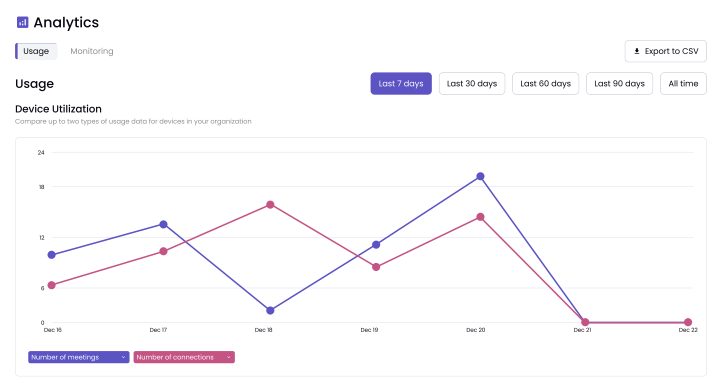
Room and device usage data is now collected end-to-end and surfaced in the admin portal under the new Analytics tab. The Device Utilization chart lets you select metrics and visualize how your fleet is used over time, giving IT and facilities teams the data they need to make informed decisions about room resources.
Fun Usernames for Web App Guest Sharers
Guest users connecting and sharing via the web app can now be assigned optional fun, auto-generated usernames. This makes it easier to identify participants in a session without requiring them to enter a name manually.
Bug Fixes
Onboarding & License Activation Reliability
Several issues affecting device onboarding and license management have been resolved:
Pods that previously failed to onboard while consuming a license seat will now complete activation cleanly.
The Assign Plan step no longer flashes during onboarding.
Re-invited users with expired invitations will no longer get stuck.
License records are now properly cleaned up when a device is deleted, and improved database indexing eliminates a class of intermittent license assignment failures.
HDMI-In Behavior on Pro and Mini
A regression that disabled HDMI-In on Pro devices has been resolved—HDMI-In now works correctly on all Pros in the field. Mini devices no longer display an HDMI-In idle-screen option that the hardware does not support, and the portal description for HDMI-In Persistent mode now updates correctly when switching between modes.
Long-Session Share Drops
Share sessions that silently dropped after 1–6 hours of continuous use are now stable. Users in extended sessions—such as all-day workshops or persistent room displays—will no longer experience unexpected disconnections.
Shared Client Screen Displayed Zoomed or Cut Off
Shared content from client devices sometimes appeared zoomed in or cropped on the room display. This rendering issue has been corrected, and the shared screens now display at the correct scale.
OTA Firmware Update from Older Versions
Over-the-air updates from older firmware versions to the current version were failing for some sites, leaving devices stuck on an outdated release. We corrected the upgrade path, and affected devices can now update successfully.
Note
For known issues carried over from previous releases—including YouTube playback delays, motion sensor polling delay, and manual calendar re-authentication—please refer to the August 2025 Release Notes.
Tip
Looking for Solstice-related release notes? View our release notes for Solstice, Solstice Cloud and Solstice Active Learning.